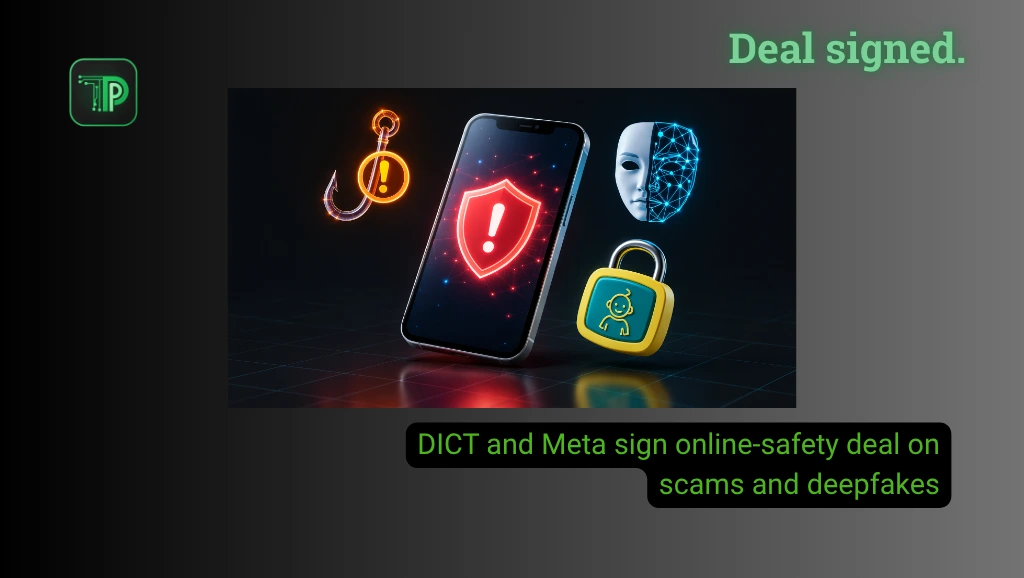
The Philippines’ Department of Information and Communications Technology (DICT) and Meta have signed an online-safety agreement. It covers online scams, AI-generated deepfakes and the exploitation of children online.
DICT Secretary Robert Joseph de Claro and Gio Tingson, Meta’s head of public policy in the Philippines, signed the memorandum of understanding (MOU) in Quezon City on Nov. 24, 2026, according to Newsbytes.PH and The Chronicle. Cybercrime Investigation and Coordinating Center (CICC) Executive Director Renato Paraiso witnessed the signing.
What the agreement covers
The two sides aim to improve coordination on scams, fraud, harmful content, deepfakes and online child exploitation. Both reports tie the deal to a directive from President Ferdinand Marcos Jr. to strengthen public-private cooperation on online safety.
- Online harms: closer cooperation against scams, AI-generated deepfakes and child exploitation.
- Digital literacy: expanded programs for children, parents and teachers on online risks and responsible platform use.
- Small businesses: support for Filipino entrepreneurs and MSMEs adopting digital tools.
For people who use Facebook, Instagram or WhatsApp in the Philippines, the deal signals more cooperation. It does not, by itself, set how fast a report will be handled or whether a specific post will be removed.
Why response times matter
The MOU follows months of talks. Newsbytes.PH reports that in April, the DICT said Meta’s reply to a joint government request fell short of its demand for specific, time-bound actions.
In August, the two sides met in Singapore and agreed to form a technical working group to speed up responses to harmful-content reports. Meta also agreed to name a point of contact for Philippine authorities.
The new agreement should be judged on what both sides do and disclose after the signing. It should not be assumed to have settled those earlier concerns.
What remains unclear
The full MOU has not been published. Neither report describes response deadlines, penalties for missed targets or a new public reporting channel. Those details matter, because broad cooperation goals are not the same as a measurable promise to act within a set time.
What users can do now
Keep using the report and security tools inside each app. Be careful with urgent requests for money, codes or account details, even when a message uses a familiar name, face or voice, since deepfakes can copy all three.
If you have already sent money to a suspected scammer, contact your bank or e-wallet right away and keep your records. Our guide on what to do after sending money to a scammer walks through the steps.
Why it matters
The MOU gives the Philippine government and Meta a formal basis to work together on scams and deepfakes. Its real impact will depend on the measures both sides put in place and how much they make public.
Is the DICT and Meta agreement a law?
No. It is a memorandum of understanding, a cooperation agreement between the DICT and Meta, not legislation.
Does the agreement set a deadline for removing reported content?
No deadline has been made public. The reports on the signing do not describe response times, penalties or a new reporting channel.
Does the agreement cover child safety?
Yes. Online child exploitation is one of its stated focus areas, along with scams and AI-generated deepfakes.
Sources: Newsbytes.PH, The Chronicle.


