
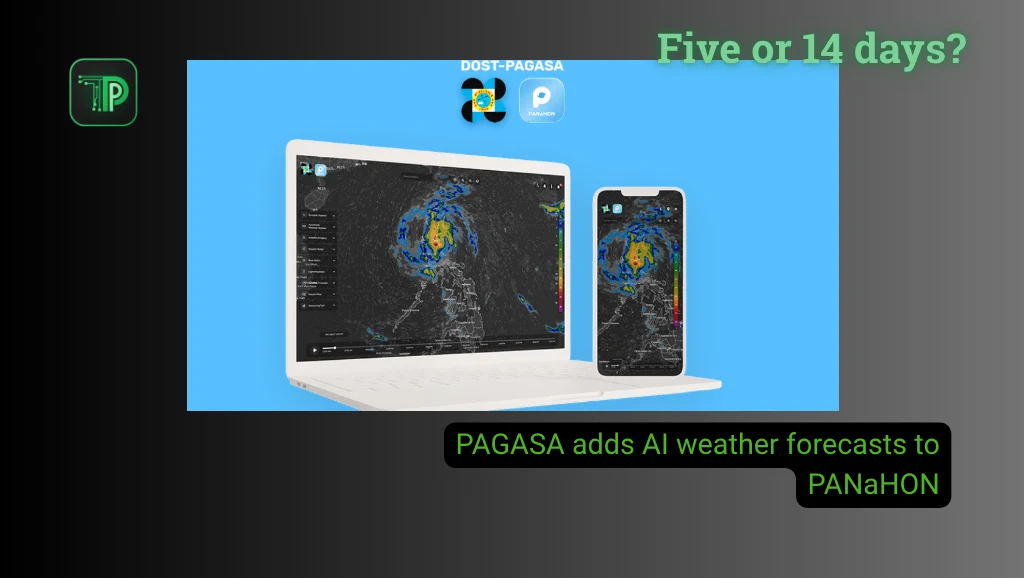
PAGASA has added an AI weather forecast layer to PANaHON, its platform for viewing weather observations and forecasts across the Philippines.
The weather bureau launched the integration on November 17 through a project with the Department of Science and Technology’s Advanced Science and Technology Institute and US-based Atmo, the Philippine News Agency reported.
PANaHON describes the new ATMO AI layer as covering the Philippines at a 2-kilometer resolution. As checked on November 18, the site says that layer displays forecasts up to five days ahead. Government officials have also discussed a 14-day AI forecasting capability, but the relationship between that longer range and the current public display needs clarification.
What is available in PANaHON?
PANaHON stands for PAGASA National Hydro-Met Observing Network. It brings together information from weather stations, including rainfall, temperature, humidity and wind, with forecast models.
The platform says users can find the ATMO AI model under its Numerical Weather Prediction layers. It also displays forecast data from the European Centre for Medium-Range Weather Forecasts. A forecast initialization time helps identify the model run behind a displayed forecast.
A 2-kilometer resolution describes the detail of the model’s data. It does not mean the forecast can predict exactly what will happen on every street or at a particular house. Actual conditions can vary within a grid cell, and forecasts can change as new information becomes available.
Why do some reports say 14 days?
In its launch report, PNA cited PAGASA Administrator Nathaniel Servando and DOST Secretary Renato Solidum Jr. discussing AI forecasts that extend up to 14 days, compared with a five-day period for conventional numerical weather prediction. PANaHON’s own description, however, says the ATMO AI layer provides forecasts up to five days ahead.
The available sources do not establish whether the longer horizon is planned, available in another system or dependent on additional resources. Readers should use the range shown in the live platform and wait for PAGASA to explain any expansion.
AI does not replace PAGASA’s other forecasts
Servando told PNA that the bureau will continue using conventional numerical weather prediction alongside AI. He also said the agency would keep evaluating and improving the model’s accuracy.
An AI-generated map is one source of forecast guidance, not a guarantee that rain, wind or flooding will occur exactly as shown. For decisions involving severe weather, check PAGASA’s current official bulletins, warnings and local government instructions, as well as the time each update was issued.
How far ahead does PANaHON show the AI forecast?
As checked on November 18, the site says the ATMO AI layer shows forecasts up to five days ahead. Officials have also discussed a 14-day capability, which the site does not describe.
Does AI replace PAGASA’s other forecasts?
No. Administrator Nathaniel Servando told PNA that PAGASA will keep using conventional numerical weather prediction alongside the AI model.
Does a 2 km resolution mean an exact forecast for my house?
No. It describes the detail of the model’s data. Conditions can vary within a grid cell, so use official bulletins and local government advisories for decisions.
Why it matters
The new layer gives Filipinos another way to explore forecast information on a government weather platform. Its practical value depends on how clearly users can read the model, understand its limits and compare it with PAGASA’s latest official advisories.
Also read: Philippines adopts AI governance framework, creates national council.
Sources: PAGASA PANaHON; Philippine News Agency, November 17.


