
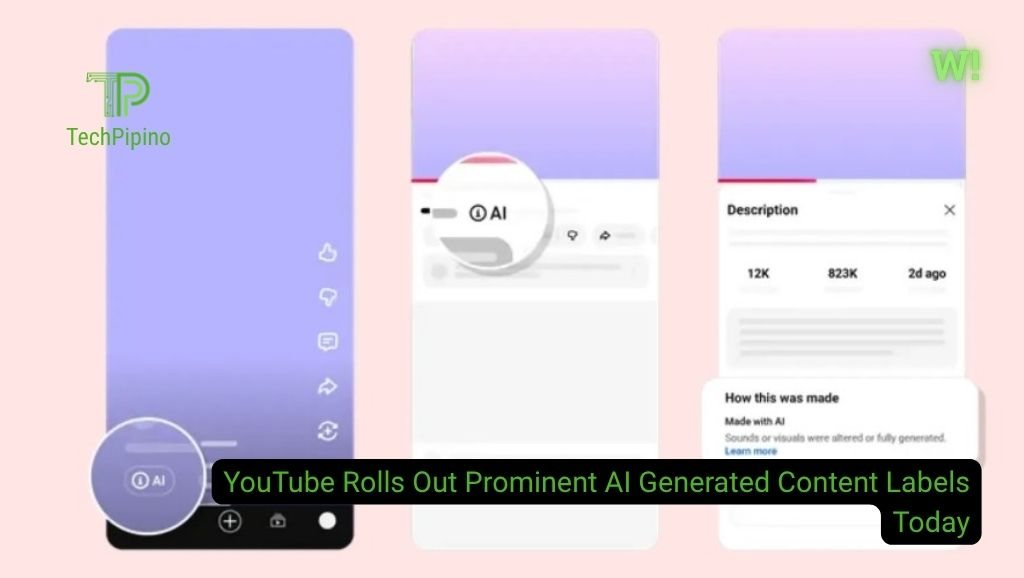
YouTube is revising its content disclosure policies, and YouTube AI generated content labels will now appear in more visible locations across both long-form videos and Shorts. The update introduces automated detection systems to enforce transparency standards, ensuring viewers can quickly identify synthetic media. This shift addresses the increasing volume of photorealistic AI outputs in the broader digital ecosystem and lessens the platform’s reliance on manual creator tagging.
Automated Detection and Provenance Systems
YouTube is shifting from a purely creator-driven disclosure model to an automated verification system. The platform will proactively scan uploads for significant photorealistic AI use. If synthetic elements are detected without manual disclosure, the system applies the label automatically. This is a critical infrastructure change, integrating metadata standards like C2PA to establish permanent digital provenance. When creators use Google ecosystem tools like Veo or Dream Screen, the metadata is hardcoded, meaning the disclosure cannot be removed. This approach mirrors the broader industry push for verifiable media, similar to how Google Photos rolled out 5 new video editing tools with strict algorithmic guardrails.
Display Mechanics and Creator Impact
The placement of these warnings is designed for immediate visibility. For standard widescreen videos, the label sits directly below the video player. For vertical content on Shorts, it appears as an active overlay on the video itself. This minimizes the friction of finding disclosures buried in expanded descriptions. While the system operates automatically, YouTube retains an appeal process within YouTube Studio for false positives.
Importantly, applying these tags does not trigger demonetization or alter the recommendation algorithm. Creators retain their reach, provided they adhere to the transparency guidelines. As synthetic media capabilities expand, such as when Google Gemini gains music creation features, the ability to consistently flag generative elements becomes a necessary baseline for platform integrity.
Quick Specs Table
| Feature | Implementation |
| Long-form Videos | Label placed directly below video player |
| Shorts | Label placed as active video overlay |
| Automated Detection | Scans for photorealistic AI usage |
| Permanent Tags | Hardcoded via Veo, Dream Screen, or C2PA data |
| Monetization Impact | None |
| Appeal Process | Manual override available via YouTube Studio |
Why It Matters
Relying on the honor system for AI disclosure is no longer a viable content moderation strategy. By implementing automated detection and permanent C2PA metadata tracking, YouTube is establishing a systemic framework to handle the influx of synthetic media. This forces accountability at the point of upload and gives viewers the immediate context required to evaluate the authenticity of what they watch.
FAQ Section
Will AI labels reduce a video’s ad revenue?
No, YouTube has confirmed that the presence of an AI label does not affect monetization eligibility or recommendation algorithms.
Can a creator remove an AI label?
If a video is incorrectly flagged by the automated system, creators can appeal and update the status in YouTube Studio. However, labels triggered by C2PA metadata or YouTube’s native AI tools are permanent.
Where do the AI labels appear on mobile?
On YouTube Shorts, the label is presented directly as an overlay on the video. For long-form content, it sits below the player and above the description.


