
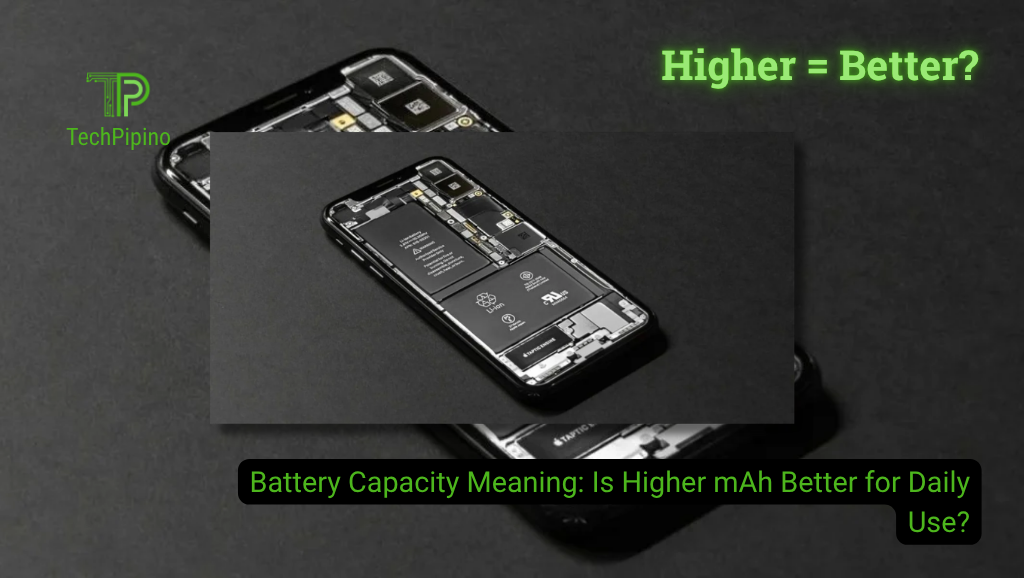
Battery capacity, measured in mAh (milliampere-hour), shows how much charge a phone can store. This guide explains battery capacity and why higher mAh doesn’t always mean better battery life in real use.
mAh Explained: What Battery Capacity Actually Measures
Battery capacity is the total amount of electric charge a battery can hold, usually measured in mAh. It helps estimate how long a phone lasts before needing a recharge, while total energy is more precisely measured in Watt-hours (Wh).
For example:
- 3000mAh = smaller capacity
- 5000mAh = larger capacity
Many assume higher mAh always means better battery life. In reality, capacity is only one part—efficiency determines how long that power lasts.
While battery capacity is measured in mAh, the actual energy also depends on voltage. That’s why two phones with the same mAh can still have different battery life.
Common Smartphone Battery Sizes: 3000mAh to 6000mAh+
| Battery Size | Typical Use Case | Expected Usage |
| 3000–4000mAh | Compact or older phones | Light to moderate use |
| 4500–5000mAh | Most modern smartphones | Full-day use |
| Over 5000mAh | Gaming or battery-focused phones | Heavy use, longer endurance |
Today, most smartphones use around 4500–5000mAh, which is considered a good battery capacity for daily use. Newer battery tech now allows some devices to reach 5500–6000mAh or even higher without increasing thickness.

Capacity vs. Efficiency: Why 5000mAh Isn’t Always Enough
Battery capacity affects how long your phone lasts, but efficiency often matters more than size.
- 5000mAh phones typically deliver around 6–8 hours of screen-on time
- Larger batteries last longer during gaming, streaming, and mobile data use
- Smaller batteries drain faster under heavy load
However, real-world battery life depends on how the phone uses power:
- Efficient processors extend battery life even with smaller batteries
- High refresh rates like 120Hz increase power consumption
- 5G uses significantly more power than Wi-Fi and is one of the biggest hidden drains
- Background processes drain battery quickly, even on large-capacity phones
Screen-on time also varies depending on usage. The same 5000mAh phone can last much longer on Wi-Fi compared to continuous 5G use.
When It Matters
It matters more if:
- You play games for long periods
- You stream videos or rely on 5G data
- You’re away from a charger most of the day
It matters less if:
- You use your phone for messaging and light browsing
- You charge your phone during the day
- The device has strong power optimization
The Efficiency Equation: Displays, Connectivity, and Thermals
For a whole-use day, capacity is only part of the equation. These factors often have a bigger impact on battery life:
- Display (OLED vs LCD): OLED saves power when showing True Black (#000000) because pixels turn off completely
- LTPO displays: Some screens can drop refresh rates as low as 1Hz, reducing power use during idle moments
- Refresh rate: 120Hz feels smoother but consumes more battery than 60Hz
- Connectivity:
- 5G drains more battery than Wi-Fi
- GPS navigation and Bluetooth accessories add continuous power usage
- NFC has minimal impact, but Always-on Display (AoD) typically consumes more idle power
- Thermals: Heat reduces efficiency and increases battery drain during heavy tasks
- Gaming: High-performance workloads quickly drain battery due to CPU and GPU usage
- Camera use: Video recording and image processing consume significant power
Software optimization is the great equalizer. It allows a well-tuned 4500mAh phone to outperform a poorly managed 5000mAh device.
Picking the Right Battery Capacity for Your Needs
Never rely on battery capacity alone when choosing a phone.
Use this as a quick guide:
- 4500mAh: Enough for light to moderate use
- 5000mAh: Best balance for most users
- 6000mAh+: Ideal for heavy use or gaming
A higher capacity is no longer the deal breaker. Software optimization, hardware efficiency, and real-world use are now major factors of battery life.
Quick Answers
What is a good battery capacity for a phone?
Around 5000mAh is considered good and usually lasts a full day for most users.
Is higher mAh always better?
No. Higher mAh helps, but efficiency, software, and usage determine actual battery life.
How long does a 5000mAh battery last?
Most 5000mAh phones last about a full day or around 6–8 hours of screen-on time, depending on usage and whether you use Wi-Fi or 5G.


