
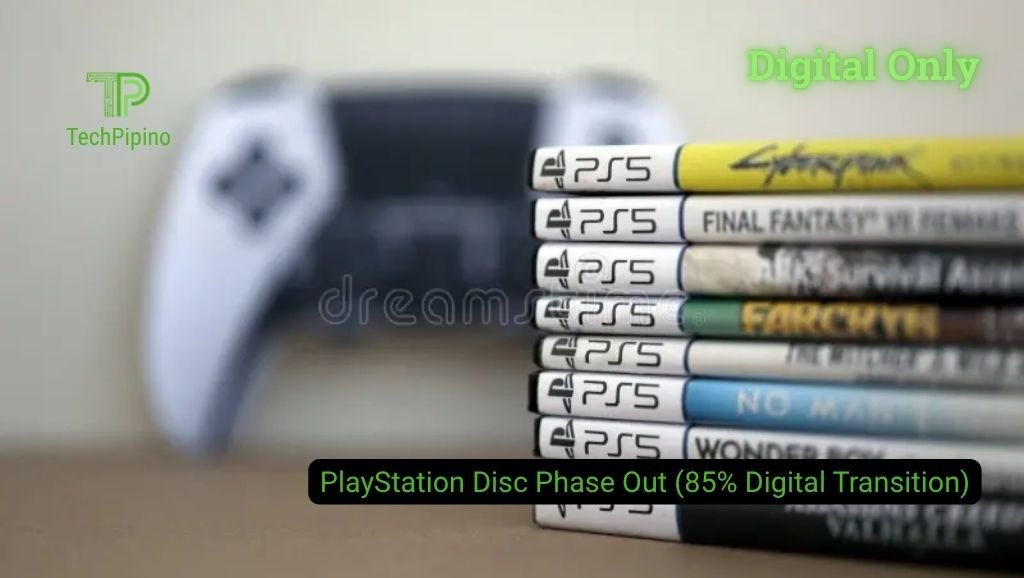
The upcoming PlayStation disc phase out represents a structured, platform-led initiative by Sony Interactive Entertainment to transition its entire console ecosystem to an all-digital distribution model by January 2028. This operational shift means all new software releases following the cutoff date will be distributed exclusively via digital channels, permanently altering physical retail supply chains and future hardware architectures. By shifting away from physical media, Sony aims to maximize profit margins, eliminate secondary market friction, and consolidate absolute control over software pricing.
The Transition Timeline and Market Re-alignment
Sony announced that physical game disc production for all new PlayStation titles will permanently cease in January 2028. Newly released software will transition entirely to digital formats, available through the proprietary PlayStation Store or via digital activation codes sold at retail outlets. This policy does not apply retroactively, meaning physical software released prior to January 2028 will remain functional on legacy hardware equipped with optical disc drives.
The roadmap aligns with broader shifts in the entertainment sector. Major intellectual properties are already moving toward digital distribution, highlighted by high-profile releases opting for a “code-in-a-box” model rather than physical Blu-ray discs. This transition follows a industry-wide decline in physical supply chains, including major electronics manufacturers phasing out dedicated Blu-ray players, large retailers removing physical media from storefronts, and entertainment companies closing down direct-to-consumer movie clubs.
The scheduled January 2028 manufacturing cutoff carries heavy architectural implications for future hardware. The timeline suggests that Sony’s next-generation platform, widely projected for a launch window near late 2027 or 2028, will debut as a digital-only console by default.
Deconstructing the 85% Digital Metric
Sony frequently highlights aggregate sales data to justify its shift away from optical media. During the fiscal quarter ending March 31, 2026, digital downloads reached a record 85% of all full-game software purchases across PlayStation platforms, leaving physical sales with a modest 15% market share. For the full fiscal year 2025, the digital ratio averaged 78% of all units, demonstrating a steady upward trajectory from 76% in fiscal year 2024.
The financial divergence becomes clearer when evaluating direct revenue streams. In the final quarter of fiscal year 2025, physical software sales brought in approximately $109 million in revenue, whereas digital software downloads generated $1.5 billion during the same three-month window. Similar patterns are observable across competing publishers:
- Capcom: Reported that 93% of its fiscal year 2025 sales were digital, with projections reaching 95.5% by 2026.
- Electronic Arts: Recorded full-game download revenues of $528 million compared to $81 million for packaged goods.
- Nintendo: Reported that digital sales grew to 54.6% of its total software volume, representing a 25% year-over-year revenue increase.
However, aggregate statistics do not tell the whole story. The 85% metric blends low-cost indie games, free-to-play titles, downloadable content (DLC), and microtransactions, which are digital by default. Data isolated for premium, first-party AAA single-player blockbusters reveals a lingering consumer preference for physical media. Historical launch data shows titles like God of War Ragnarök and Ratchet & Clank: Rift Apart maintaining physical unit shares as high as 76%, while even recent blockbusters like Marvel’s Spider-Man 2 retained a 54% physical sales allocation. The phase-out is therefore a proactive, platform-driven maneuver to force consumer habits forward rather than a passive reaction to organic market demand.
Economic Realities of Platform Control
The core driver behind eliminating optical discs is the optimization of software distribution margins. Physical retail environments dilute software revenue through distribution intermediaries, manufacturing costs, and retail markups. Digital storefront transactions allow platform holders to capture a far more lucrative share of the transaction.
| Distribution Format | Retailer Margin | Platform Fee / License | Mfg & Logistics Cost | Publisher Net Share |
| Third-Party Digital | 0% | 30% | 0% | 70% |
| Third-Party Physical | ~30% | 15% | ~5% | ~50% |
| First-Party Digital (Sony) | 0% | 0% | 0% | 100% |
| First-Party Physical (Sony) | ~30% | 0% | ~5% | ~65% |
Beyond margin capture, an all-digital ecosystem addresses the secondary games market. Used game sales generate zero royalty revenue for publishers and platform developers. Eliminating physical media systematically dismantles the secondhand ecosystem, forcing consumers seeking legacy games to purchase licenses directly from the PlayStation Store.
This shift establishes an effective monopoly over game distribution, removing the price competition historically driven by independent retailers. The structural risks of a closed marketplace are highlighted by the Caccuri v. Sony Interactive Entertainment class-action lawsuit filed in 2021, which challenged Sony’s policy of barring third-party retailers from selling digital download vouchers. The lawsuit resulted in a preliminary $7.85 million settlement in April 2026, underscoring consumer vulnerabilities when physical distribution alternatives are eliminated.
Modular Hardware Transitions and Platform Lock-in
Sony’s hardware strategy has systematically paved the way for a diskless future. The launch of the original PlayStation 5 models established a $100 price differential between the optical drive version ($499) and the Digital Edition ($399), incentivizing early digital adoption.
The introduction of subsequent hardware revisions, specifically the mid-generation slim models and the high-end PlayStation 5 Pro, shifted to a modular approach. These units feature a digital-first baseline configuration, requiring consumers to purchase a separate detachable optical disc drive accessory for $79.99. This allows Sony to standardize its manufacturing pipeline and lower overall shipping costs.
| Console Configuration | Hardware Included |
| Standard Out-of-the-Box | PS5 Pro / Slim Digital Chassis |
| Optional Add-on (+$79.99) | Detachable Ultra HD Blu-ray Disc Drive |
This modular configuration introduces notable challenges regarding hardware longevity. The external disc drive requires an active internet connection to authenticate and register with the console motherboard during setup. If authentication servers are retired in the future, players will lose the ability to pair replacement drives, threatening long-term backward compatibility. This hurdle is heightened by a global $100 price increase on PlayStation 5 hardware in early 2026, driven by rising semiconductor costs and intense competition for artificial intelligence components.
Cultural Backlash and the Preservation Crisis
The digital-only transition faces resistance due to the legal shift from true ownership to temporary licensing. Physical purchases grant consumers a tangible asset protected by the first-sale doctrine, allowing them to resell, lend, or preserve the media. Digital purchases grant a non-transferable license that remains subject to terms of service and can be unilaterally revoked.
This vulnerability was highlighted in late 2026 when a licensing dispute forced the removal of over 500 purchased digital movie titles from user libraries without financial compensation. Such incidents fuel concerns over game preservation, as physical media often serves as the only permanent record of a console’s library once storefronts close.
The economic impact on lower-income households is another major focal point, as a digital ecosystem removes access to budget-friendly secondhand games, rentals, and peer-to-peer sharing. The transition has triggered sharp criticism from consumer advocacy groups and independent retailers, who face existential threats as physical software distribution shifts from a mainstream market into a highly specialized niche.
Verdict
The 2028 PlayStation disc phase out is a definitive, platform-led maneuver designed to secure absolute control over the gaming ecosystem. While it streamlines console manufacturing and maximizes profit margins for publishers, it strips away consumer benefits tied to physical media, such as retail price competition, secondhand trade-in value, and permanent offline ownership. For the end user, this transition marks the conclusion of the traditional console ownership model, fully absorbing the medium into a closed, corporate-managed digital service.
Frequently Asked Questions
When will Sony stop producing physical PlayStation game discs?
Sony will permanently discontinue the production of physical game discs for all new PlayStation titles starting in January 2028, making all subsequent software digital-only.
Will my existing physical PlayStation discs work after the 2028 phase-out?
Yes, the transition will not retroactively affect older games, meaning physical discs released prior to January 2028 will continue to function on console hardware equipped with compatible disc drives.
Why is Sony removing the disc drive from its console ecosystem?
The shift to an all-digital ecosystem optimizes software profit margins, eliminates the secondary used-game market, and gives the platform holder absolute control over software pricing and distribution.
What happens to digital game ownership if server authentication goes offline?
Digital purchases are non-transferable licenses rather than physical assets, meaning access can be altered or lost if authentication servers are retired, licensing agreements expire, or account access changes.


