
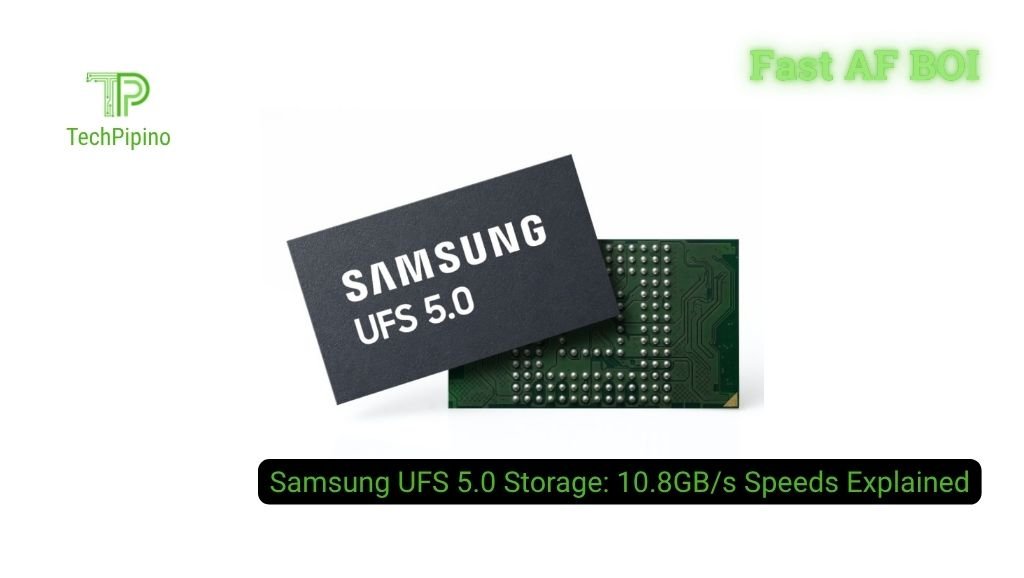
Samsung has officially unveiled its next-generation UFS 5.0 embedded storage, a critical architectural upgrade designed to resolve data bottlenecks in mobile on-device artificial intelligence. By achieving sequential read speeds of 10.8GB/s and write speeds of 9.5GB/s, this standard moves mobile storage into the performance tier typically reserved for high-end desktop PCIe Gen 4 solid-state drives.
Architecting for On-Device AI
The primary driver for this transition is the shift from cloud-based AI to local processing. Large Language Models (LLMs) require rapid, consistent data retrieval to function with minimal latency. Current storage standards often create a bottleneck where the processor remains idle while waiting for the next data block.
By leveraging the latest JEDEC embedded interface specifications, UFS 5.0 doubles the throughput of UFS 4.1. This is not merely a benchmark improvement; it represents a fundamental change in how devices handle large datasets. Faster storage enables lower latency for complex AI queries, smoother multitasking, and reduced app load times.
Efficiency and Form Factor
Samsung has implemented advanced power management techniques, specifically clock gating and multi-voltage scaling, to improve power efficiency by over 40% compared to UFS 4.1. These metrics are vital for mobile devices where thermal envelopes are strictly limited.
Furthermore, the physical architecture of the UFS 5.0 component measures 7.5mm x 13mm x 0.9mm. This 16.7% size reduction compared to the previous generation provides manufacturers with additional internal space. This recovered real estate can be utilized for expanded cooling solutions or higher-density battery modules, directly impacting the sustained performance capabilities of future flagship handsets.
Technical Specifications
| Specification | UFS 5.0 Metric |
| Sequential Read Speed | Up to 10.8GB/s |
| Sequential Write Speed | Up to 9.5GB/s |
| Efficiency Gain | >40% vs UFS 4.1 |
| Package Size | 7.5mm x 13mm x 0.9mm |
| Mass Production Start | Q4 2026 |
| Maximum Capacity | 1TB |
Why It Matters
As generative AI tasks move onto the device, the storage interface has evolved from a simple repository into a fundamental component of the computational pipeline. The arrival of UFS 5.0 ensures that memory bandwidth scales in tandem with increasingly sophisticated mobile chipsets, preventing hardware throttling and enabling more responsive, privacy-focused local AI experiences.
FAQ
What is the primary benefit of UFS 5.0 for AI?
It significantly reduces latency and improves response times for on-device LLMs by providing high-bandwidth data access that keeps pace with modern processors.
How does UFS 5.0 compare to UFS 4.1 in speed?
UFS 5.0 offers approximately twice the performance, with sequential read speeds of 10.8GB/s compared to the 4.3GB/s ceiling of UFS 4.1.
When will devices with UFS 5.0 be available?
Mass production begins in the fourth quarter of 2026, meaning the first consumer devices featuring this hardware will likely arrive in early 2027.
Will UFS 5.0 impact battery life?
Yes, the 40% improvement in power efficiency helps reduce the energy cost of data transfers, which contributes to longer battery life during intensive tasks.


