
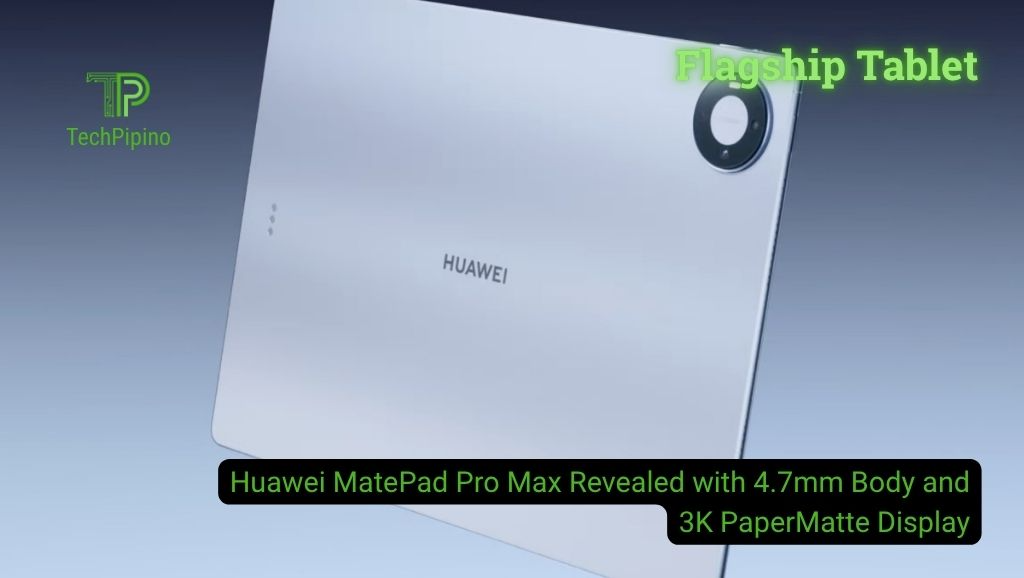
Huawei has officially teased the Huawei MatePad Pro Max, confirming a record breaking 4.7mm ultra slim profile and a high resolution 13.2-inch OLED PaperMatte display ahead of its global debut in Bangkok. This flagship tablet aims to redefine the intersection of portable industrial design and professional grade visual fidelity, moving away from the bulk associated with large format slates.
Industrial Design and Display Systems
The most striking technical achievement of the MatePad Pro Max is its 4.7mm thickness. This is not merely an aesthetic choice: a chassis this thin requires advanced thermal dissipation materials to manage the heat generated by the internal Kirin 9-series silicon. By reducing the physical distance between the heat source and the exterior casing, Huawei must rely on high conductivity vapor chambers to prevent thermal throttling during sustained workloads.
The 13.2-inch OLED PaperMatte display features a 3K resolution and ultra slim 3.55mm bezels, achieving a high screen to body ratio that minimizes the overall footprint of the device. The PaperMatte technology uses nano level etching to reduce light reflection and improve the tactile response when used with a stylus. This system is designed to mitigate eye strain and provide a consistent viewing experience under harsh overhead lighting, which is a common failure point for standard glossy IPS LCD vs OLED panels.
Performance and Connectivity Architecture
Under the hood, the MatePad Pro Max is reported to run on a Kirin 9-series chipset. This integration is crucial for Huawei’s ecosystem, as it allows for deeper optimization between the hardware and the HarmonyOS architecture. The inclusion of 66W fast charging ensures that the downtime for such a large device is kept to a minimum, though the thinness of the device suggests a sophisticated battery stacking solution to maintain a competitive battery capacity.
Perhaps the most significant addition is the rumored satellite communication support. This system allows for emergency messaging and data transmission in areas without cellular coverage, transforming the tablet from a standard productivity tool into a critical communication hub for field professionals.
Quick Specs Comparison
| Feature | Specification |
| Display | 13.2-inch 3K OLED PaperMatte |
| Thickness | 4.7mm |
| Processor | Kirin 9-series (Reported) |
| Charging | 66W Fast Charging |
| Bezels | 3.55mm |
| Connectivity | Satellite Support (Variant dependent) |
Why It Matters
The Huawei MatePad Pro Max represents a shift in tablet engineering where extreme thinness is paired with professional utility. By integrating specialized display coatings and satellite connectivity, Huawei is targeting a niche of power users who require high performance without the weight of a traditional laptop. The success of this device will depend on whether the 4.7mm frame can provide the structural integrity and thermal headroom required for pro-level creative tasks.
FAQ Section
How thin is the Huawei MatePad Pro Max?
The tablet measures just 4.7mm thick, making it the slimmest model in Huawei’s current tablet lineup.
What is a PaperMatte display?
It is a specialized OLED panel that uses nano-etching to reduce glare and mimic the texture of paper for better stylus input and eye comfort.
Does the MatePad Pro Max support satellite communication?
According to reports from industry tipsters, there will be a specific variant of the tablet that supports satellite messaging.
What chipset does the MatePad Pro Max use?
While not officially confirmed by Huawei, reports indicate it will be powered by a flagship Kirin 9-series processor.


